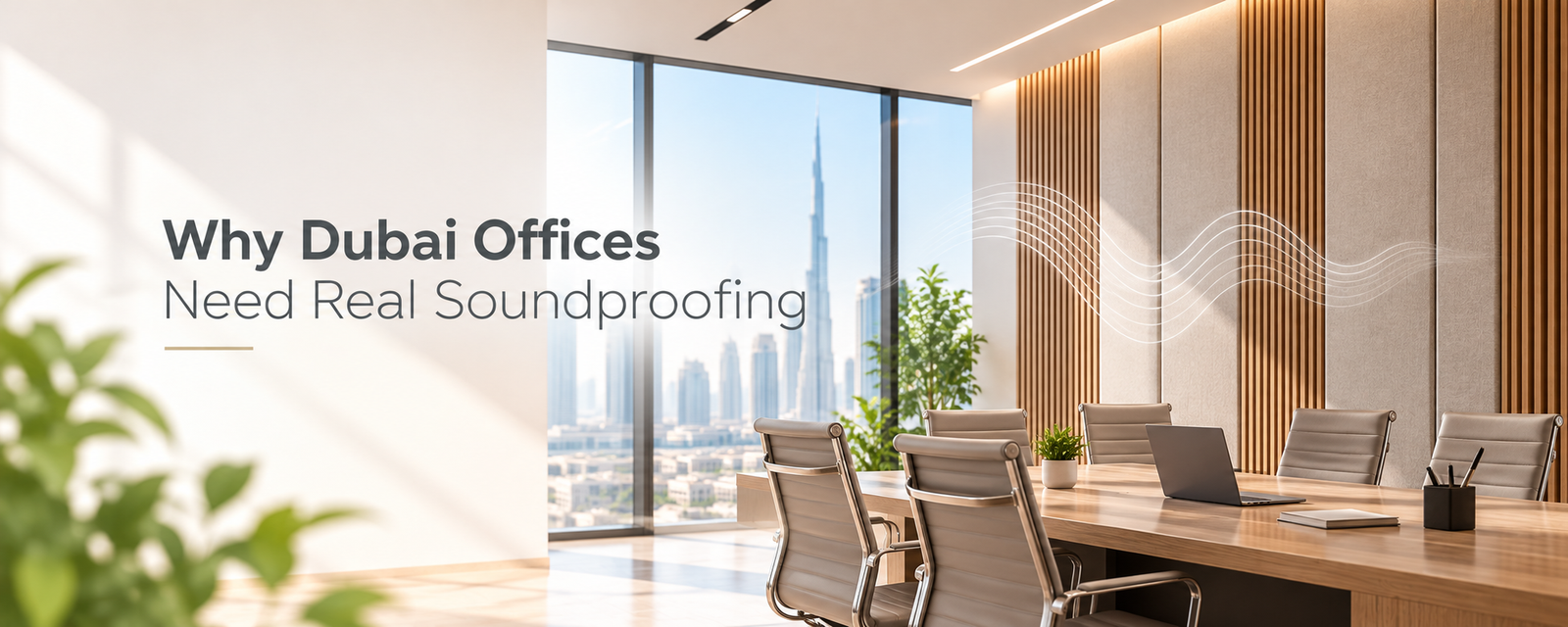
It’s 3pm, someone’s on a client call in the open plan area because both meeting rooms are booked, and six people within earshot have just lost their concentration mid task. Nobody’s being inconsiderate. The office just wasn’t built to handle sound, and now it’s quietly costing the company focus time nobody’s tracking on a spreadsheet, but everybody feels by Thursday.
Dubai’s commercial real estate is dense, and open plan layouts dominate the fit out market because they’re efficient on floor space and look great in a leasing brochure. What they don’t do particularly well, without proper acoustic treatment, is let people actually concentrate or hold a confidential conversation. That gap between how an office looks and how it actually functions is where most soundproofing conversations start.
What “Office Soundproofing” Actually Means
The term gets used loosely, and it covers two genuinely different problems that need different fixes. Reverberation and echo inside the space, the general noise level and clarity of an open plan floor, is an absorption problem, solved with ceiling and wall treatment that soaks up sound rather than letting it bounce around. Privacy between rooms, stopping a confidential call in a meeting room from being audible outside it, is a blocking problem, solved with mass, sealed partitions, and proper door and glazing details.
Most “soundproofing didn’t work” complaints trace back to this mix up. A company installs acoustic panels expecting meeting room privacy and gets disappointed when colleagues can still hear muffled conversation through the wall, because panels solve echo, not transmission. Privacy needs a different intervention entirely, usually starting with the wall and door assembly rather than anything applied to a surface inside the room.
The Real Cost of a Noisy Office
Research into open plan noise consistently links high ambient sound levels to measurable drops in concentration, increased stress, and lower reported job satisfaction, and anyone who’s worked in a loud office doesn’t need the research to believe it. The harder number to put on a spreadsheet is retention. Employees who find an office genuinely hard to concentrate in, and increasingly hard to find quiet space within, notice that friction daily, and in a competitive hiring market across Dubai, that friction matters more than most facilities budgets account for.
| Office Problem | Root Cause | Fix |
| General noise, hard to concentrate | Reverberation off hard ceilings, walls, floors | Ceiling baffles, wall panels, absorptive flooring elements |
| Meeting rooms overheard outside | Insufficient wall mass or sealing gaps | Mass loaded partition, sealed door, acoustic glazing |
| Phone booths not actually private | Sound leaking through small gaps and thin panels | Properly sealed enclosure with rated door and glazing |
| Mechanical hum from HVAC or plant | Vibration transfer through structure | Isolation mounts, duct lining, enclosure treatment |
| Open plan calls disturbing neighbours | No designated acoustic zone | Dedicated booths plus general absorption treatment |
Where the Treatment Actually Goes
For most open plan Dubai offices, the most consistent result comes from combining ceiling and wall treatment rather than relying on one or the other. Acoustic ceiling baffles treat the largest available surface efficiently, especially useful where ceiling height allows vertical hanging panels without disrupting lighting and services layouts already in place. Paired with acoustic fabric panels at key reflection points on walls, particularly around meeting rooms and high traffic desk clusters, that combination handles the general reverberation problem most offices are actually dealing with.
Meeting room privacy is a different project entirely, and worth being upfront about, that usually involves assessing the existing partition wall construction, sealing penetrations and gaps around services, and sometimes upgrading door seals or glazing specification, rather than adding more panels to a wall that’s already acoustically fine inside the room.
Phone booths and focus pods have become a standard fixture in Dubai co working spaces and corporate offices alike, and they fail at privacy surprisingly often, usually because a small gap under the door or around a glazed panel undoes an otherwise well specified enclosure. Sound finds the weakest point in any assembly, and a booth that’s 95% sealed can still leak enough through that last 5% to defeat the purpose entirely.
The Assessment Comes Before the Quote
The offices that get the best result are the ones that start with an actual assessment rather than a catalogue order. What’s the room volume, what’s the existing wall and ceiling construction, where specifically is the complaint coming from, general noise or a specific privacy concern. That diagnosis changes the recommendation substantially, and skipping it is how companies end up with panels on a wall that never needed them while the actual privacy problem in the next room over goes untouched.
Our engineers run this assessment the same way across every office project, measuring the space, modelling the expected outcome before specifying materials, and installing with our own trained crews rather than subcontracting the work out. That matters more in office fit outs than people expect, because occupied offices need treatment installed around working desks and existing furniture without disrupting operations for weeks, which takes genuine site coordination, not just a crew showing up with panels.
As more companies across Dubai push employees back toward office based work, acoustic comfort has become part of the retention conversation rather than a facilities afterthought. An office that’s genuinely pleasant to concentrate in is a quieter kind of competitive advantage, one that shows up in how long people stay rather than in a single line item anyone budgets for upfront.
Is your office dealing with general noise, or a specific privacy problem in meeting rooms and booths? Tell us which, and we’ll tell you where to start.