
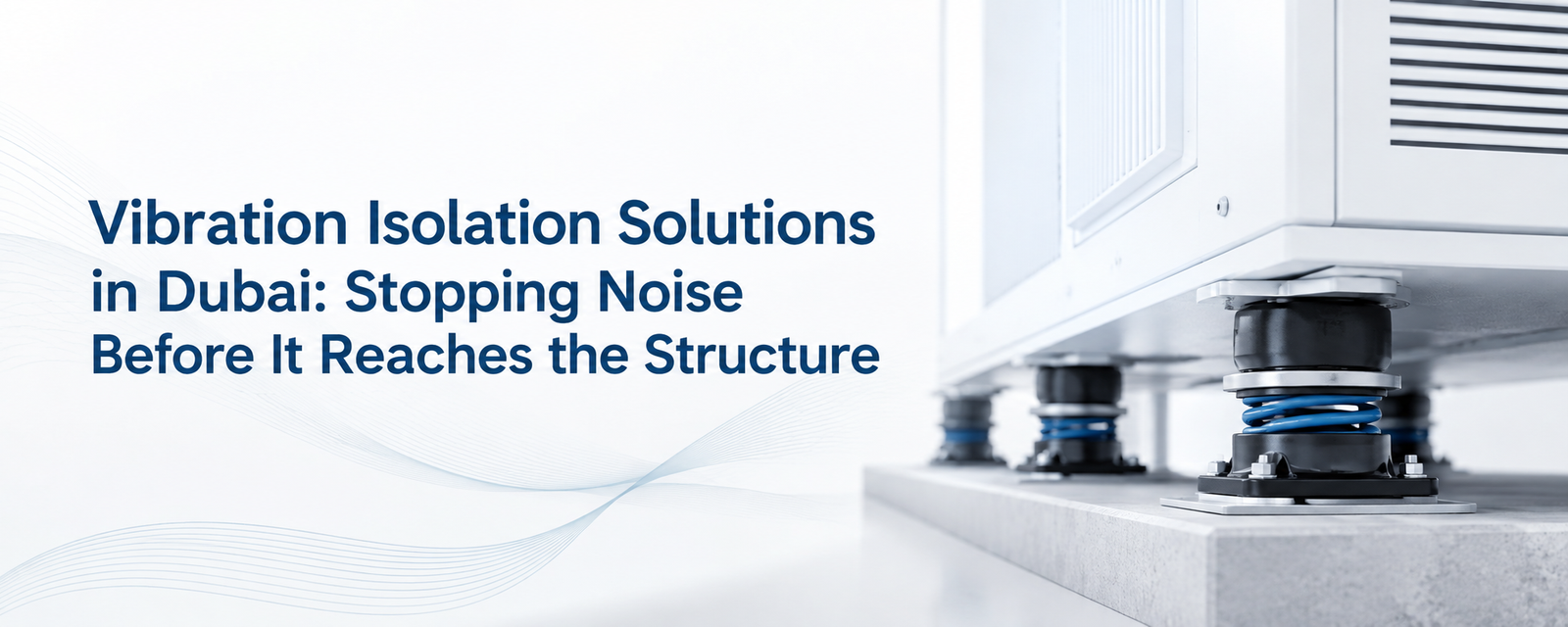
Vibration isolation solutions separate a vibrating piece of equipment, a pump, a chiller, a generator, an AHU, from the structure it sits on, so the mechanical energy it produces never gets the chance to travel through concrete, steel, and pipework and turn into noise somewhere else in the building. AKINCO specifies and installs spring isolators, rubber-in-shear mounts, isolation pads, and flexible connectors sized to the exact load and operating frequency of each piece of equipment, and we do it as part of a wider acoustic assessment rather than as a standalone product sale.
What Vibration Isolation Actually Does
Every rotating or reciprocating machine produces vibration. A chiller compressor, a generator engine, a pump impeller, they all move mass, and that movement creates a force that has to go somewhere. If the equipment sits directly on a concrete slab with no isolation, that force transfers straight into the structure. From there it can travel remarkably long distances through columns, floor slabs, and risers before it reappears three floors away as a low hum in a boardroom ceiling or a rattle in a hotel room above a plant room.
Vibration isolation solutions break that path. A correctly selected isolator absorbs the energy at the source and dissipates it as a small amount of heat instead of letting it pass into the building. The equipment still runs, still vibrates, but the structure around it stays quiet.
How Vibration Becomes Noise Inside a Building
This is the part that catches a lot of consultants and contractors off guard. Vibration and noise are not the same thing, but one causes the other. A pump running in an isolated plant room can be almost silent to someone standing next to it and still be audible two floors up, because the vibration is travelling through the structure rather than the air. Concrete and steel carry low-frequency vibration over long distances with very little loss of energy, which is exactly why a generator room at the basement level of a tower can end up as a complaint on the fifteenth floor.
Get the isolation wrong and no amount of acoustic panelling on the walls of the plant room will fix the problem, because the noise isn’t travelling through the air in that room in the first place. This is why AKINCO treats vibration isolation as a structural decision, not a finishing touch.
The Vibration Isolation Products We Work With
Not every piece of equipment needs the same solution, and specifying the wrong isolator is almost as bad as specifying none at all. Our range, sourced through certified UK and European manufacturers including our partner Vibro Isolation Limited, covers:
- Spring isolators, used under heavy rotating equipment like chillers and cooling towers where low-frequency vibration needs a soft, high-deflection mount
- Neoprene and rubber-in-shear mounts, suited to lighter equipment such as small pumps, fan coil units, and AHUs
- Isolation pads and mats, laid under equipment bases or floating floor systems where a distributed, lower-cost solution is appropriate
- Hanger isolators, which support suspended pipework and ductwork so vibration doesn’t transfer through hangers into the slab above
- Flexible connectors and expansion joints, which stop vibration travelling along rigid pipe and duct runs even when the equipment itself is properly isolated
Each of these has a load rating and a natural frequency, and matching the isolator to the equipment is where the actual engineering happens.
Where Vibration Isolation Gets Specified
Plant rooms and generator rooms sit at the top of the list, simply because the equipment inside them is heavy, runs continuously, and is often located close to occupied space. Chiller and AHU installations on rooftops need isolation not just for the occupants below but for the surrounding neighbourhood in dense developments. Pump rooms, water tank installations, and rooftop mechanical yards all carry the same risk. In performance spaces, recording studios, and cinemas, isolation extends further, into floating floor systems and isolated wall constructions, because even foot traffic and HVAC vibration from an adjacent space can compromise the acoustic integrity of the room.
Vibration Isolation Is Not the Same as Acoustic Insulation
One of the more common misunderstandings we run into on site is treating vibration isolation and acoustic insulation as interchangeable. They solve different problems. Acoustic insulation, foam, fabric panels, mineral wool, deals with airborne sound, the noise that travels through the air and needs to be absorbed or blocked. Vibration isolation deals with structure-borne sound, the noise that never travels through the air at all until it re-emerges somewhere far from its source. A space can be fully treated acoustically on the walls and ceiling and still have a serious noise problem if the vibration source underneath it was never isolated correctly. Getting both right, in the right order, is the difference between a space that actually performs and one that looks treated but still has a complaint sitting in it.
Why AKINCO for Vibration Isolation in the UAE
AKINCO’s acoustic engineers, several of them certified by the Institute of Acoustics in the UK, model the vibration path before recommending an isolator, using simulation software to predict how the structure will behave once equipment is running. We source isolation products from certified manufacturers in the UAE, Europe, and the UK, including our specialist partner Vibro Isolation Limited, and we install every solution with our own trained teams rather than subcontracting the work out. Over 1,000 completed projects across the UAE have taught us that a vibration problem caught at design stage costs a fraction of what it costs to fix after handover, when the slab is poured and the equipment is running.
Frequently Asked Questions
What is vibration isolation and why does a building need it?
Vibration isolation stops mechanical vibration from equipment such as pumps, chillers, and generators from transferring into a building’s structure, where it can travel long distances and reappear as noise in spaces far from the original source.
How do I know if I have a vibration problem or a noise problem?
If a space is quiet when the source equipment is off and develops a hum, rattle, or low-frequency noise when it’s running, the issue is very likely vibration transferring through the structure rather than sound travelling through the air.
Can vibration isolation be retrofitted to existing equipment?
In most cases, yes. AKINCO regularly assesses existing plant rooms and mechanical installations and specifies isolators that can be fitted without a full equipment replacement, though the scope depends on access and the current mounting arrangement.
Does AKINCO handle vibration isolation across the whole of the UAE?
Yes. We assess, specify, supply, and install vibration isolation solutions for projects across Dubai, Abu Dhabi, Sharjah, and the wider UAE, working directly with contractors, consultants, and facility management teams.
