
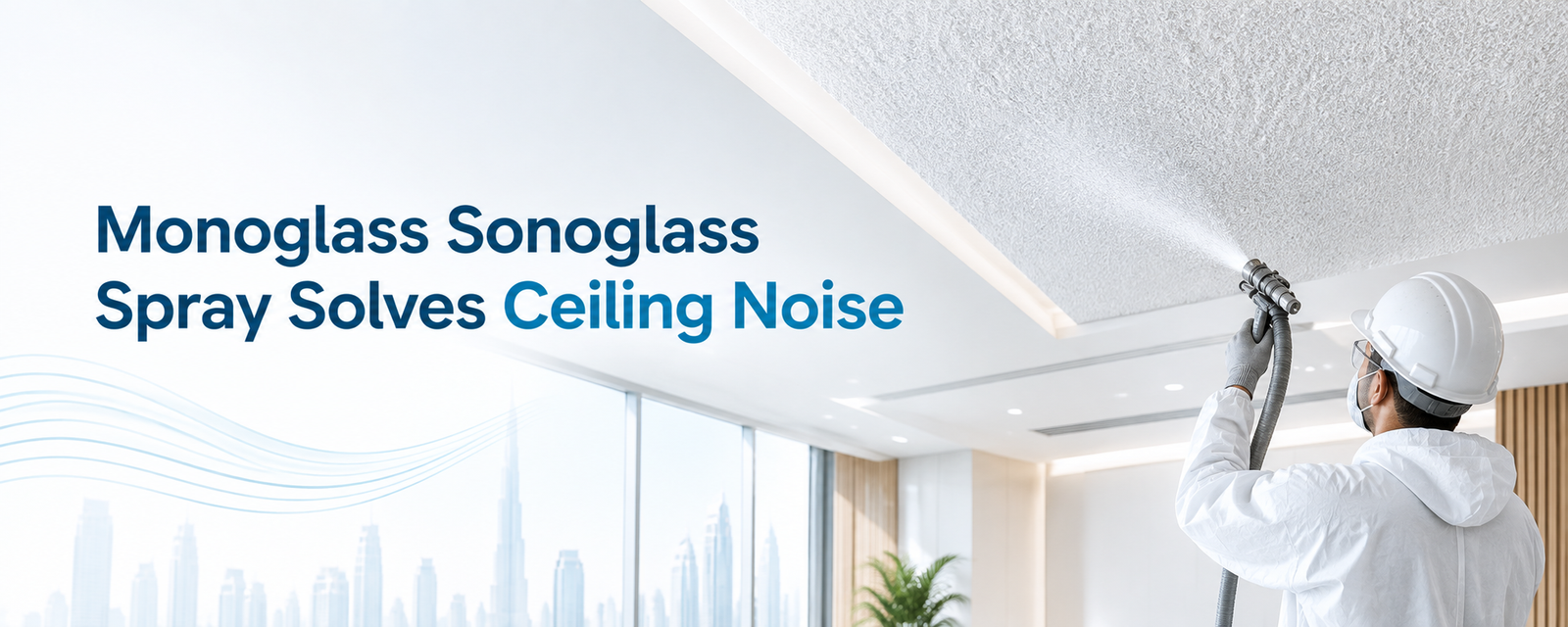
Picture a warehouse ceiling forty feet up, corrugated steel deck, exposed structure, echo bouncing so hard you can barely hear a forklift horn from thirty metres away. Now try fitting acoustic panels up there. Framing, access towers, weeks of labour, and half the surface is curved or interrupted by ductwork anyway. This is exactly the situation where most standard acoustic products just give up. It’s also exactly where Sonoglass spray earns its keep.
We get asked about this product constantly, usually by contractors staring at a ceiling that doesn’t fit any off the shelf panel size. So let’s actually explain what it is, how it behaves on site, and where it makes sense versus where it doesn’t.
What Monoglass and Sonoglass Actually Are
Monoglass Incorporated developed the Spray-On line back in 1979, when a contractor named Douglas Eyrl needed a spray applied fiberglass insulation that could hit higher R-values than the cellulose sprays available at the time, without the mess and settling issues those older products had. Nearly five decades later, the formulation has evolved but the core idea hasn’t. It’s a fiberglass based, water applied insulation that goes on wet and cures into a lightweight, textured mat.
Sonoglass is the acoustic focused variant within that same product family, engineered specifically for sound absorption rather than thermal performance alone, though it does both. It’s composed of fine glass wool fibres mixed with a binding agent, applied through pressurised spray equipment directly onto the ceiling or wall substrate. As it cures it forms a continuous, slightly textured layer with no seams, no joints, and no visible fixings.
AKINCO is the exclusive distributor for Monoglass and Sonoglass across the MENA region, and we’re one of a small number of applicators in the UAE trained and equipped to install it correctly, which matters more than people expect. Spray coverage rate, mix consistency, and cure conditions all affect the final acoustic result, and getting those wrong is how a spray job ends up patchy or underperforming.
Why It Works Where Panels Can’t
Sound absorption depends on surface area and material density interacting with sound waves, and Sonoglass tackles that differently from a rigid panel. Because it’s sprayed on wet, it fills every irregularity in the substrate, corrugations, joints, curves, without needing a frame or fixing system. Once cured, sound energy entering the fibrous mass gets absorbed and dissipated rather than reflected straight back into the room.
That single property, adhering to almost any surface shape, is what makes it the practical answer for spaces that a flat panel simply can’t cover efficiently.
| Application | Why Sonoglass Fits | Typical Alternative and Its Limit |
|---|---|---|
| Curved or vaulted ceilings | Conforms to any shape, no cutting or templating | Rigid panels need custom fabrication, expensive |
| Corrugated steel decking | Fills the profile completely in one pass | Baffles leave gaps between the flutes |
| Gymnasiums and sports halls | Covers large area fast, handles impact resistance | Fabric panels risk damage from balls, equipment |
| Places of worship, high ceilings | No visible fixings, blends with architecture | Panels need access equipment and bracket work |
| Parking structures, plant rooms | Non combustible, tolerates dust and moisture | Foam degrades, absorbs less over time |
The Fire and Health Angle That Actually Matters
This is a detail a lot of buyers skip past, and it shouldn’t be skipped. Sonoglass is non combustible, made with recycled glass content (roughly 58% in the standard formulation), and it’s approved for application directly over structural fireproofing without compromising the fire rating underneath. That’s a genuinely useful property on steel deck projects where the fireproofing spec and the acoustic spec would otherwise compete for the same surface.
It’s also low emitting. The product meets the California Department of Public Health’s CDPH Standard Method v1.1 criteria for low emitting materials, the same benchmark commonly referenced for school and office interior specifications in the UAE. If you’re specifying acoustic treatment for an occupied building, that’s not a small footnote, it affects indoor air quality sign off.
Where It Doesn’t Make Sense
Being straight about limits matters here. Sonoglass is not the answer if the client wants a polished, architectural finish with sharp lines and a specific colour palette, boardrooms and hotel lobbies usually call for acoustic fabric panels or wooden panel systems instead. It’s also not a substitute for mass when the real problem is airborne noise transfer through a wall between two tenancies, that calls for a denser barrier product, and for impact noise between floors, floating floor systems do the actual job.
Sonoglass earns its place specifically on exposed structural ceilings, industrial spaces, and irregular surfaces where absorption and thermal performance both matter, and where a visible, textured finish is acceptable or even preferred.
What Application Day Actually Looks Like
Installation requires specialised equipment that mixes the fibre with the binder right at the nozzle, so build up happens in controlled passes rather than one thick coat. Curing time depends on ambient humidity and thickness, and Dubai’s summer humidity swings do affect scheduling, which is one reason working with an applicator who handles this material regularly (rather than occasionally) actually matters. Get the mix ratio wrong and you either waste material through overspray or end up with an underperforming, thin layer that looks fine but doesn’t absorb what the spec called for.
As demand grows across the UAE for retrofitting older industrial stock and fitting out large format retail and logistics space, more contractors are specifying spray applied acoustic solutions instead of trying to force panel systems onto surfaces they were never designed for. It’s a shift we’ve watched happen steadily over the last few years, and it tracks with the wider push toward faster, less labour intensive fitout methods across the region.
If you’re staring down a ceiling that no standard panel wants to fit, tell us the surface type and the span, corrugated steel, concrete waffle slab, curved plaster, whatever it is. We’ll tell you honestly whether spray is the right call or if something else fits better.
What kind of ceiling or surface are you trying to treat? Drop the details below and we’ll point you toward the right fix.
