
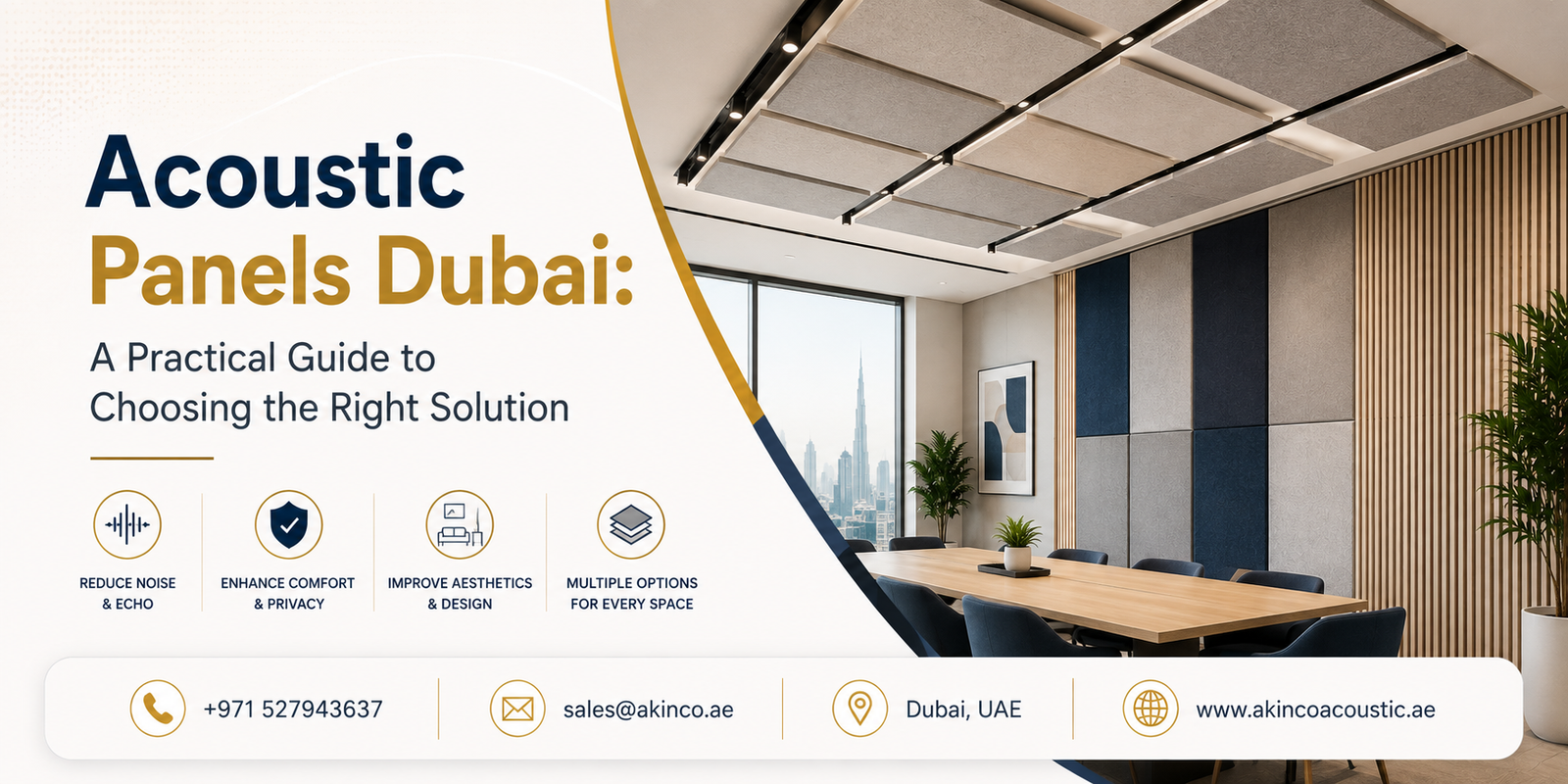
Search “acoustic panels Dubai” and you’ll find dozens of products that all promise to fix noise problems. What most of those listings won’t tell you is that acoustic panels aren’t one product — they’re a category covering several genuinely different materials, each built for a different kind of noise problem. Picking the wrong one is a common and expensive mistake.
This guide breaks down the main types of acoustic panels available in Dubai, which noise problems each one actually solves, and how to think through the decision before you buy.
Acoustic Panels Aren’t All Solving the Same Problem
Before comparing products, it helps to separate the two things acoustic treatment actually does, because they’re often confused:
Sound absorption reduces echo and reverberation inside a room — it makes the space itself sound better, but it doesn’t stop sound from traveling to the room next door.
Sound insulation blocks noise from passing between spaces — it protects privacy and reduces disturbance between rooms, but doesn’t necessarily improve how a single room sounds internally.
Here’s the practical distinction worth remembering: if your problem is an echoey, noisy room, you need absorption products; if your problem is hearing your neighbor’s meeting through the wall, you need insulation products — and most projects actually need some combination of both. Buying an absorption panel to solve an insulation problem, or vice versa, is one of the most common wasted purchases in acoustic treatment.
The Main Types of Acoustic Panels
| Panel type | Primary function | Typical application |
| Acoustic foam panels | Absorption | Studios, home offices, small meeting rooms |
| Acoustic fabric panels | Absorption, with a finished visual look | Offices, hospitality, retail |
| Acoustic stretch fabric wall systems | Absorption over a larger continuous surface | Boardrooms, auditoriums, cinemas |
| Wooden acoustic panels | Absorption plus a premium visual finish | Reception areas, boardrooms, hotels |
| Acoustic ceiling baffles | Absorption without a ceiling replacement | Open offices, warehouses, gyms |
| Acoustic spray-applied finishes | Absorption on irregular surfaces | Retrofits, industrial ceilings |
| Acoustic vinyl barriers | Insulation | Between floors, plant room walls |
| Floating floors | Insulation against footfall noise | Multi-story residential, hotels, offices above occupied space |
Foam panels tend to get the most attention because they’re visually recognizable and widely marketed, but they’re actually one of the more limited options — well suited to smaller spaces like studios and home offices, less practical for large open-plan commercial areas where coverage needs to be far greater.
How Space Type Changes the Right Choice
Corporate offices typically need a mix of ceiling baffles or tiles and some wall absorption to reduce overall noise buildup in open-plan areas, plus insulation between meeting rooms for privacy.
Hospitality spaces — hotels, restaurants — often lean toward wooden panels or fabric systems that double as a design feature, since the acoustic treatment is also part of what guests see.
Recording studios and cinemas generally need the most comprehensive treatment, combining absorption for internal sound quality with serious insulation to prevent sound leakage in either direction.
Schools prioritize absorption specifically for speech clarity, since the core problem is usually a teacher’s voice getting lost in classroom reverberation.
Industrial and plant spaces often center on managing mechanical noise, which may call for spray-applied finishes or barriers rather than the decorative panel types used in offices.
Where Materials Actually Come From
Panel quality varies significantly between manufacturers, and country of origin often correlates with the testing and certification behind a product. Materials sourced from established acoustic manufacturers across Europe, the UK, and the UAE — rather than uncertified generic imports — tend to come with documented performance data that a certified supplier can actually show you, rather than a marketing claim you have to take on faith.
AKINCO sources its range from certified manufacturers including specialists in acoustic plaster, wooden panels, spray-applied insulation, wood wool panels, acoustic foam, and acoustic barriers across the UAE, Europe, and the UK — giving Dubai-based buyers access to a genuinely wide material range rather than a single product line dressed up as a full catalogue.
A Practical Way to Approach the Decision
Rather than starting with a product, start with the problem:
- Name the actual complaint. Is it echo inside a room, noise coming from another room, or mechanical noise from equipment?
- Identify the space’s primary use. A boardroom, an open office, and a plant room have completely different acoustic priorities.
- Get the space assessed before buying anything. A proper site visit and simulation will show what level of treatment is actually needed — often less dramatic (and less expensive) than a worst-case assumption.
- Match the panel type to the diagnosis, not the other way around. Choosing a product first and hoping it solves the problem is how projects end up needing a second round of work.
Common Questions About Acoustic Panels in Dubai
Do acoustic panels actually reduce noise from outside a building?
Standard acoustic panels are primarily built for internal absorption or room-to-room insulation — external noise from traffic or construction usually needs a different approach involving the building envelope itself, such as glazing or wall insulation upgrades.
Are acoustic panels required by UAE building codes?
Requirements vary by project type and sector — schools, healthcare, and hospitality projects often have specific acoustic performance standards as part of design approval, which is worth checking with your project consultant early.
Can acoustic panels be added to an already-finished space?
Yes — ceiling baffles, wall-mounted fabric panels, and spray-applied finishes are all commonly used specifically because they don’t require major structural work, making them practical retrofit options for existing offices and buildings.
Getting the Right Panels for Your Space
Acoustic panels only work when the type matches the actual problem, and Dubai’s market has enough product variety that guessing rarely lands on the right answer the first time. A proper site assessment, before any purchase decision, is what separates an effective acoustic project from an expensive trial and error process.
AKINCO has completed over 1,000 acoustic projects across Dubai and the wider UAE, supplying and installing the full range of absorption and insulation products from a single accountable team.