
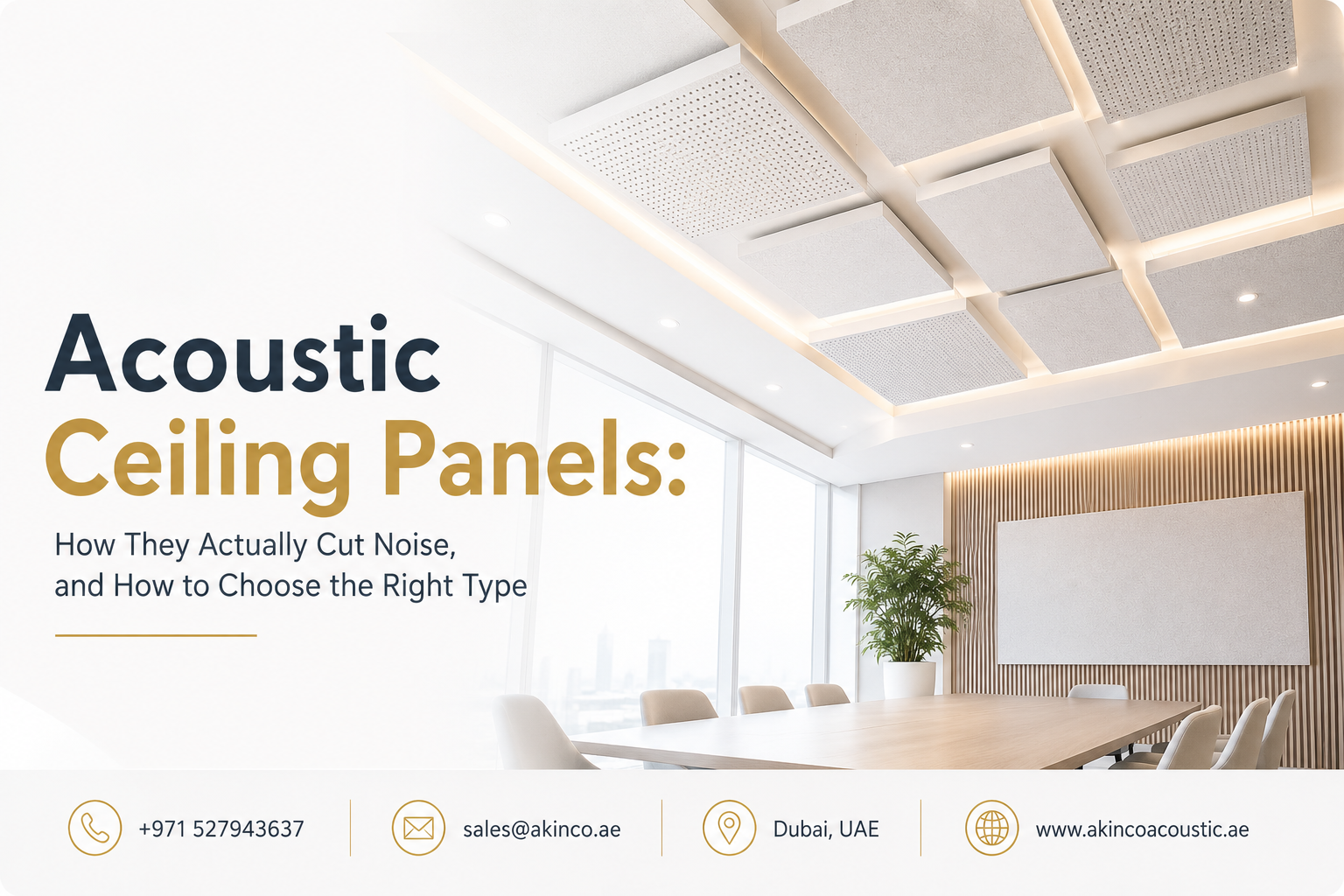
Walk into a room with a hard, flat ceiling and a room with acoustic ceiling panels, and the difference is immediate — even before anyone speaks. One space has that harsh, echoing quality where every sound bounces around and lingers. The other feels calmer, and conversations stay where they belong instead of carrying across the whole floor. That difference comes down almost entirely to what’s happening above your head.
This guide explains how acoustic ceiling panels actually work, which types suit which spaces, and what to check before choosing a product or installer.
What Acoustic Ceiling Panels Actually Do
Here’s the core mechanism worth understanding first: acoustic ceiling panels absorb sound energy as it hits the ceiling surface, converting it to a small amount of heat instead of reflecting it back into the room — which is what reduces echo, reverberation, and overall noise buildup in a space.
A standard hard ceiling — concrete, gypsum board, or plain drywall — reflects almost all sound energy back into the room. In a large open office or a hall with a high ceiling, that reflected sound keeps bouncing until it gradually decays, and in the meantime it stacks on top of every new conversation or noise happening in the room. That’s what causes the tired, straining feeling of trying to hold a conversation in a loud open-plan office.
Types of Acoustic Ceiling Panels
Not all ceiling acoustic treatments look or perform the same way. The main categories worth knowing:
| Type | How it works | Best suited for |
| Acoustic ceiling baffles | Vertical hanging panels that increase total absorption surface area without a full ceiling replacement | Open offices, warehouses, gyms, cafeterias |
| Acoustic ceiling tiles | Flat, mounted panels that replace or sit within an existing grid | Offices, classrooms, healthcare corridors |
| Wooden acoustic panels | Perforated or slatted wood surfaces that absorb sound while adding a visual finish | Reception areas, boardrooms, hospitality spaces |
| Acoustic spray-applied finishes | Sprayed directly onto the ceiling surface for seamless coverage | Irregular ceiling shapes, retrofit projects, industrial spaces |
Baffles are worth calling out specifically because they solve a problem flat panels can’t: in a space with an already-finished ceiling, hanging baffles adds significant absorption area without tearing out and replacing what’s there. That makes them one of the more practical retrofit options for existing offices and warehouses.
Where Ceiling Panels Matter Most
Not every room needs the same level of ceiling treatment, and the type of space changes what actually needs solving:
- Open-plan offices — the priority is usually reducing overall noise buildup and conversational carry across the floor.
- Schools and classrooms — a teacher’s voice needs to stay clear at the back of the room, which means controlling reverberation specifically.
- Auditoriums and event spaces — the goal shifts to controlling how sound decays over time, so speech and music stay intelligible without excessive echo.
- Healthcare corridors — noise control supports both patient comfort and staff communication in high-traffic areas.
- Industrial and plant spaces — the priority is often managing mechanical noise transfer rather than speech clarity.
Choosing a panel type without first identifying which of these problems you’re actually solving is one of the most common mistakes in acoustic treatment — a product chosen for its appearance alone can leave the original noise complaint completely unresolved.
Why Modeling the Result Matters Before Installation
Acoustic performance isn’t something you can eyeball from a product spec sheet. Ceiling height, room volume, existing hard surfaces, and the specific frequency of the noise problem all affect how much absorption a space actually needs — and installing the wrong coverage often means redoing the work later.
This is where acoustic simulation software earns its place in the process. Modeling the expected result before installation begins lets an acoustician show, with data, what a proposed panel type and coverage will actually achieve in that specific room — rather than installing based on a generic recommendation and hoping it’s enough.
What to Ask Before Choosing a Ceiling Panel Product
- What’s the actual noise problem — reverberation, sound transfer, or mechanical noise? Different problems call for different solutions, and a supplier should ask this before recommending a product.
- Has the space been assessed and modeled, or is this a generic recommendation? A proper acoustic recommendation is based on the room’s specific dimensions and surfaces.
- Are the materials certified for UAE building standards? This matters for both performance and code compliance on commercial projects.
- Does the panel type fit the space’s use — office, classroom, auditorium, industrial? A panel great for an open office may be the wrong choice for a lecture hall.
- Who’s actually installing it — the supplier’s own team, or a subcontractor? Installation quality affects real-world performance as much as the product itself.
How AKINCO Approaches Ceiling Acoustic Treatment
AKINCO is a specialist acoustic treatment company based in Dubai, with acoustic engineers, designers, and senior acousticians certified by the Institute of Acoustics (IOA) in the UK. Every project starts with a site assessment to identify the actual noise problem, followed by acoustic simulation modeling to show what a proposed solution will achieve before installation begins.
The ceiling panel range includes acoustic ceiling baffles, wooden acoustic panels, and spray-applied finishes, sourced from certified manufacturers across the UAE, Europe, and the UK. Installation is carried out by AKINCO’s own trained teams rather than subcontractors, across more than 1,000 completed projects spanning offices, schools, hospitals, hotels, cinemas, and industrial facilities throughout the UAE.
Getting the Right Ceiling Treatment for Your Space
Acoustic ceiling panels solve a real, measurable problem — but only when the type and coverage are matched to what’s actually happening in the room. A quick product order based on appearance alone often means paying for a second round of work later.
If you’re weighing options for an office, classroom, or larger commercial space, AKINCO can carry out a site assessment and model the expected result before you commit to a product.