
Elevate Your Space with Expert Services
We also utilize our Research Department to develop customized products to satisfy your every need. AKINCO has the most advanced software tools available to accurately simulate the finalized acoustic result. AKINCO is committed to personal attention to your project. At AKINCO, we will go the extra step to solving your Space and Noise Control concerns.
Contact Us
-
send email sales@akinco.ae
-
call agent +971-527943637
get notification
Auditorium Acoustics
- Akinco Acoustic
- Auditorium Acoustics
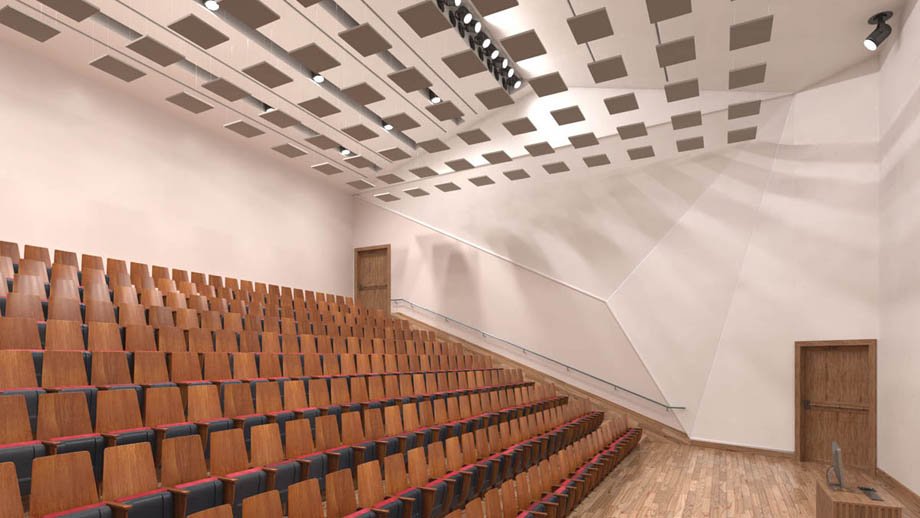
Professional Auditorium Acoustic Design Solutions
Every Seat Deserves to Hear It Clearly
An auditorium is only as good as what the last row hears. You can have the best speaker, the finest performer, or the most important presentation in the room and if the acoustics are wrong, the experience falls apart before it reaches half the audience.
Auditorium acoustic design is not something you can patch after the fact. It needs to be engineered into the space from the beginning, factoring in the room’s volume, shape, surface materials, seating arrangement, and how the space will actually be used. Done right, every seat in the room from the front row to the back corner of the balcony receives clear, balanced sound without echo, without flutter, and without the kind of reverberation that turns speech into noise.
AKINCO provides professional auditorium acoustic design across the UAE, working with architects, project developers, educational institutions, government facilities, and fitout contractors to deliver spaces that perform exactly the way they were designed to.
Why Auditorium Acoustics Cannot Be an Afterthought?
Most rooms can tolerate average acoustic treatment and still function. Auditoriums cannot. The combination of large volume, hard boundary surfaces, mixed seating configurations, and the expectation of speech or music clarity makes auditorium acoustic design UAE one of the most technically demanding disciplines in architectural acoustics.
The common problems that show up when acoustic design is overlooked or under-specified include:
- Excessive reverberation that blurs speech and makes words run into each other
- Echo from the rear wall or balcony face
- Uneven sound distribution across the seating area
- Background noise from HVAC systems bleeding into the listening environment
Each of these problems has a specific engineering solution. None of them are solved by placing foam panels on a few walls and calling it done.
What Auditorium Acoustic Design Actually Involves
Every auditorium acoustic design project AKINCO undertakes begins with a detailed assessment of the space and its intended use. A conference hall used primarily for speech has different acoustic targets than a multi-purpose auditorium that needs to handle both amplified music and unamplified lectures. These differences drive every design decision.
Reverberation Time Control
Reverberation time is one of the most critical parameters in any auditorium. Too long, and speech becomes unintelligible. Too short, and the space sounds flat and lifeless — particularly problematic for music performance. AKINCO’s engineers calculate the optimal reverberation time for each auditorium based on its volume and primary use, then specify the right combination of absorptive and reflective surfaces to hit that target precisely.
Sound Distribution and Coverage
Sound needs to reach every seat at an appropriate level. This means designing ceiling and wall geometry to direct early reflections toward the audience, avoiding configurations that create dead zones, and ensuring rear seating positions are not disadvantaged. AKINCO uses acoustic modelling software to simulate sound distribution before any material is specified or installed.
Echo and Flutter Elimination
Parallel hard surfaces are the primary cause of flutter echo in auditoriums. Rear walls that face the stage directly are also a common source of discrete echo. AKINCO addresses both through carefully calculated placement of diffusive and absorptive materials across the rear wall, side walls, and ceiling.
Background Noise Management
An auditorium’s acoustic performance is only as good as the ambient noise floor allows. HVAC systems, mechanical plant, and external traffic noise can all compromise speech intelligibility if not properly controlled. AKINCO’s engineers assess background noise levels as part of every auditorium acoustic design project and recommend the appropriate noise control measures alongside room treatment.
Acoustic Material Selection and Integration
The acoustic products specified for an auditorium need to perform at the right frequencies while meeting the visual and regulatory requirements of the space. AKINCO supplies and installs wooden acoustic panels, fabric-wrapped panels, acoustic ceiling systems, diffuser arrays, and specialist wall linings all integrated into the design intent of the space, not added as an afterthought.
Types of Auditoriums We Design For
Auditorium acoustic design requirements vary significantly depending on the space type and its primary function. AKINCO has delivered acoustic design solutions across a wide range of auditorium types throughout the UAE.
Corporate and Conference Auditoriums
Large presentation halls in corporate headquarters require speech clarity above everything else. Reverberation times need to be kept short, background noise tightly controlled, and the acoustic treatment integrated cleanly into a professional interior finish.
Educational Auditoriums and Lecture Theatres
University halls, school auditoriums, and lecture theatres see high daily usage and variable seating configurations. Acoustic design for educational spaces must ensure that a speaker at the front of the room is clearly understood at every seat — without amplification becoming a crutch for poor acoustic design.
Multi-Purpose Halls and Community Centres
Spaces that need to function for both speech and music performance present the most complex acoustic brief. AKINCO works with carefully balanced absorption-to-diffusion ratios to make multi-purpose auditoriums genuinely adaptable rather than a compromise in both directions.
Performing Arts Venues and Concert Halls
Music performance spaces have demanding acoustic requirements with far less tolerance for error. AKINCO’s IOA-UK certified acousticians bring the technical rigour these projects require, from shaping early lateral reflections to specifying diffuser geometry that gives the space its character and depth.
Government and Institutional Auditoriums
Ceremonial halls, government assembly rooms, and institutional auditoriums require acoustic design that meets formal performance standards, handles large audiences, and integrates with interior specifications that are often complex and tightly controlled.
AKINCO’s Auditorium Acoustic Design Process
We do not sell acoustic products and then reverse-engineer a justification for them. Every AKINCO auditorium project follows a structured design process that leads with engineering and ends with a space that performs to specification.
Step 1 Assessment A thorough review of architectural drawings, room dimensions, proposed surface finishes, and intended use.
Step 2 Acoustic Modelling Our team builds a simulation of the space, models its performance against target parameters, and develops a treatment strategy that is acoustically effective and buildable within the project’s constraints.
Step 3 Design Integration We work alongside the project’s design and construction teams to ensure the acoustic specification translates correctly into installation.
Step 4 Supply and Installation AKINCO manages product sourcing, installation, and post-installation testing across all auditorium projects in the UAE.
-
Instant Business Growth
-
24/7 Quality Service
-
Easy Customer Service
-
Quality Cost Service
At what stage of a project should auditorium acoustic design begin?
As early as possible — ideally at the architectural design stage before structural decisions are finalised. Room shape, ceiling height, balcony geometry, and surface material choices all have a direct impact on acoustic performance. Addressing these early is far more effective and cost-efficient than retrofitting treatment into a finished space.
Can AKINCO improve the acoustics of an existing auditorium?
Yes. Acoustic remediation of existing auditoriums is a significant part of our work. AKINCO carries out site measurements, identifies the specific acoustic deficiencies, and designs a treatment solution that can be installed without requiring major structural changes.
How long does an auditorium acoustic design project take?
The timeline varies depending on the size and complexity of the space. For a straightforward corporate auditorium, the design phase typically takes a few weeks. Larger performing arts venues require more detailed modelling and coordination. AKINCO provides a project-specific timeline during the initial consultation.
Does AKINCO handle auditorium acoustic design across the UAE?
Yes. AKINCO delivers auditorium acoustic design across Dubai, Abu Dhabi, Sharjah, Al Ain, and Ras Al Khaimah, as well as across the wider region including Saudi Arabia and Oman.
What acoustic products are typically used in auditorium design?
The product mix depends on the specific acoustic targets and design intent of the space. Common treatments include wooden acoustic panels, fabric-wrapped absorption panels, acoustic diffusers, acoustic ceiling tiles, and bespoke wall linings. AKINCO specifies products that meet both the performance requirement and the visual standard of the project.
How do you ensure the design performs as intended after installation?
AKINCO carries out post-installation acoustic measurements to verify the space is performing within target parameters. The goal is not just to install acoustic products, it is to deliver a space that genuinely works.
